Lebonsiteimmobilier
Add a review FollowOverview
-
Founded Date February 13, 1948
-
Area of Expertises Corporate
-
Posted Jobs 0
-
Viewed 154
Company Description
Nvidia Stock May Fall as DeepSeek’s ‘Amazing’ AI Model Disrupts OpenAI
HANGZHOU, CHINA – JANUARY 25, 2025 – The logo of Chinese artificial intelligence company DeepSeek is … [+] seen in Hangzhou, Zhejiang province, China, January 26, 2025. (Photo credit need to check out CFOTO/Future Publishing through Getty Images)
America’s policy of limiting Chinese access to Nvidia’s most innovative AI chips has actually inadvertently assisted a Chinese AI designer leapfrog U.S. rivals who have complete access to the company’s newest chips.

This shows a basic reason startups are frequently more effective than big business: Scarcity generates development.
A case in point is the Chinese AI Model DeepSeek R1 – an intricate problem-solving model taking on OpenAI’s o1 – which “zoomed to the global top 10 in performance” – yet was built even more quickly, with less, less effective AI chips, at a much lower cost, according to the Wall Street Journal.
The success of R1 should benefit enterprises. That’s due to the fact that business see no factor to pay more for an effective AI model when a cheaper one is available – and is likely to enhance more quickly.
“OpenAI’s model is the best in performance, but we likewise do not wish to pay for capabilities we do not need,” Anthony Poo, co-founder of a Silicon Valley-based start-up utilizing generative AI to forecast financial returns, told the Journal.
Last September, Poo’s company moved from Anthropic’s Claude to DeepSeek after tests showed DeepSeek “carried out similarly for around one-fourth of the expense,” noted the Journal. For example, Open AI charges $20 to $200 monthly for its services while DeepSeek makes its platform available at no charge to private users and “charges only $0.14 per million tokens for developers,” reported Newsweek.
Gmail Security Warning For 2.5 Billion Users-AI Hack Confirmed
When my book, Brain Rush, was released last summer, I was concerned that the future of generative AI in the U.S. was too depending on the biggest technology business. I contrasted this with the creativity of U.S. start-ups throughout the dot-com boom – which spawned 2,888 initial public offerings (compared to zero IPOs for U.S. generative AI startups).
DeepSeek’s success might encourage new competitors to U.S.-based big language model designers. If these startups construct powerful AI designs with less chips and get improvements to market quicker, Nvidia profits could grow more slowly as LLM developers duplicate DeepSeek’s strategy of using fewer, less innovative AI chips.
“We’ll decline remark,” composed an Nvidia representative in a January 26 email.
DeepSeek’s R1: Excellent Performance, Lower Cost, Shorter Development Time
DeepSeek has actually impressed a leading U.S. endeavor capitalist. “Deepseek R1 is one of the most remarkable and remarkable developments I have actually ever seen,” Silicon Valley investor Marc Andreessen composed in a January 24 post on X.
To be reasonable, DeepSeek’s technology lags that of U.S. competitors such as OpenAI and Google. However, the business’s R1 design – which introduced January 20 – “is a close rival regardless of utilizing fewer and less-advanced chips, and sometimes avoiding steps that U.S. developers thought about important,” kept in mind the Journal.
Due to the high expense to deploy generative AI, business are significantly wondering whether it is possible to earn a positive roi. As I wrote last April, more than $1 trillion could be bought the technology and a killer app for the AI chatbots has yet to emerge.
Therefore, organizations are excited about the potential customers of decreasing the investment needed. Since R1’s open source model works so well and is a lot cheaper than ones from OpenAI and Google, business are keenly interested.
How so? R1 is the top-trending design being downloaded on HuggingFace – 109,000, according to VentureBeat, and matches “OpenAI’s o1 at simply 3%-5% of the cost.” R1 also offers a search function users judge to be superior to OpenAI and Perplexity “and is just rivaled by Google’s Gemini Deep Research,” noted VentureBeat.
DeepSeek established R1 more quickly and at a much lower expense. DeepSeek stated it trained among its latest designs for $5.6 million in about 2 months, noted CNBC – far less than the $100 million to $1 billion range Anthropic CEO Dario Amodei cited in 2024 as the expense to train its models, the Journal reported.
To train its V3 model, DeepSeek utilized a cluster of more than 2,000 Nvidia chips “compared with 10s of countless chips for training models of similar size,” noted the Journal.
Independent analysts from Chatbot Arena, a platform hosted by UC Berkeley researchers, rated V3 and R1 designs in the leading 10 for chatbot performance on January 25, the Journal wrote.
The CEO behind DeepSeek is Liang Wenfeng, who manages an $8 billion hedge fund. His hedge fund, called High-Flyer, utilized AI chips to build algorithms to determine “patterns that could impact stock prices,” kept in mind the Financial Times.
Liang’s outsider status helped him succeed. In 2023, he launched DeepSeek to develop human-level AI. “Liang constructed an extraordinary facilities group that really understands how the chips worked,” one founder at a rival LLM company told the Financial Times. “He took his best individuals with him from the hedge fund to DeepSeek.”
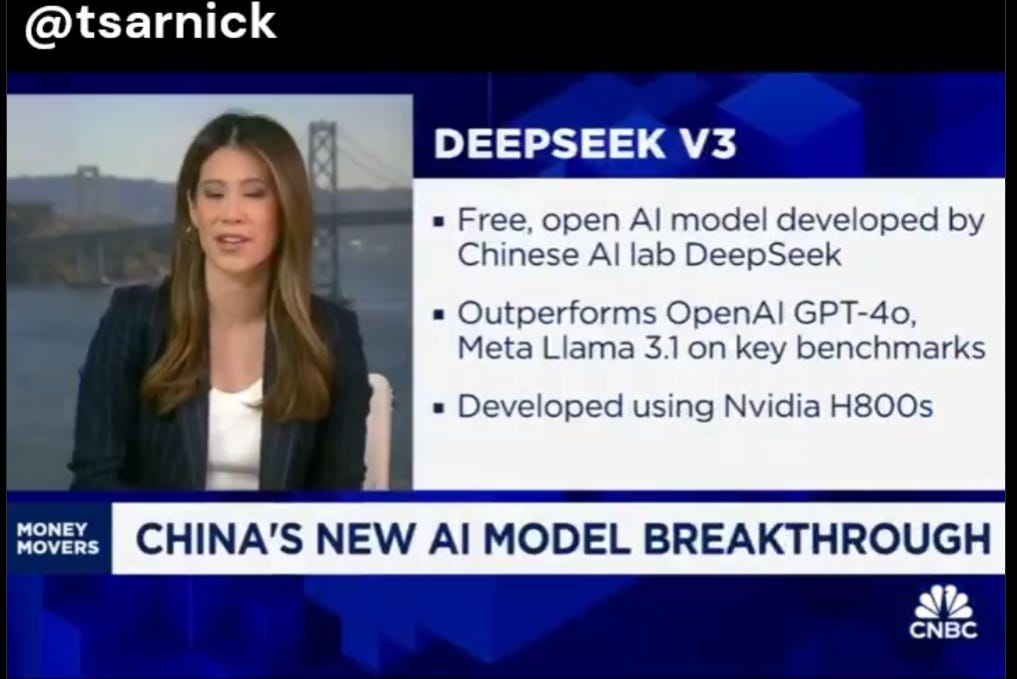
DeepSeek benefited when Washington prohibited Nvidia from exporting H100s – Nvidia’s most effective chips – to China. That required local AI business to engineer around the scarcity of the restricted computing power of less powerful regional chips – Nvidia H800s, according to CNBC.
The H800 chips transfer data in between chips at half the H100’s 600-gigabits-per-second rate and are typically more economical, according to a Medium post by Nscale chief business Havard. Liang’s group “already understood how to solve this issue,” noted the Financial Times.
To be fair, DeepSeek said it had actually stockpiled 10,000 H100 chips prior to October 2022 when the U.S. imposed export controls on them, Liang informed Newsweek. It is unclear whether DeepSeek used these H100 chips to develop its models.
Microsoft is extremely pleased with DeepSeek’s accomplishments. “To see the DeepSeek’s brand-new model, it’s extremely outstanding in terms of both how they have actually actually efficiently done an open-source model that does this inference-time calculate, and is super-compute effective,” CEO Satya Nadella stated January 22 at the World Economic Forum, according to a CNBC report. “We should take the advancements out of China really, really seriously.”
Will DeepSeek’s Breakthrough Slow The Growth In Demand For Nvidia Chips?
DeepSeek’s success should stimulate modifications to U.S. AI policy while making Nvidia financiers more mindful.
U.S. export constraints to Nvidia put pressure on start-ups like DeepSeek to prioritize effectiveness, resource-pooling, and collaboration. To produce R1, DeepSeek re-engineered its training procedure to use Nvidia H800s’ lower processing speed, previous DeepSeek staff member and existing Northwestern University computer technology Ph.D. student Zihan Wang told MIT Technology Review.

One Nvidia scientist was enthusiastic about DeepSeek’s achievements. DeepSeek’s paper reporting the results revived memories of pioneering AI programs that mastered board games such as chess which were developed “from scratch, without imitating human grandmasters initially,” senior Nvidia research researcher Jim Fan stated on X as included by the Journal.
Will DeepSeek’s success throttle Nvidia’s development rate? I do not understand. However, based upon my research study, businesses plainly want effective generative AI designs that return their investment. Enterprises will be able to do more experiments targeted at finding high-payoff generative AI applications, if the expense and time to construct those applications is lower.
That’s why R1’s lower cost and much shorter time to carry out well must continue to bring in more commercial interest. A key to delivering what organizations want is DeepSeek’s ability at enhancing less effective GPUs.
If more start-ups can replicate what DeepSeek has achieved, there might be less demand for Nvidia’s most expensive chips.
I do not know how Nvidia will respond must this happen. However, in the brief run that could mean less profits development as startups – following DeepSeek’s technique – construct designs with fewer, lower-priced chips.